Showing posts with label hyper-connectivity. Show all posts

Don't twitter on my Internet and call it lifestreaming

Some time ago now, I ran across Twitter and blogged briefly about the potentiality of "microblogging" or, for more grandiose terminology, "lifestreaming". Since then, I (like anyone else with one ear to mainstream tech-news headlines) have naturally been aware of its expansion into all corners of the web world, lending itself to so many offshoots and modifications personified in an impressive array of homemade widgetry. I lumped it together with the whole Web 2.0 trend, which, it is evident, not only saw the advent of blogs, but the simultaneously and rapid desubstantification* of the written word to bite-sized morsels of gooey, self-absorbed blandness streamed tidily to your handset in RSS.

Granted, this process had long since begun (read: countless and all-pervasive social networking sites). But I feel like it has gone hand in hand with the Web 1.0->2.0 bait-and-switch of adding comment tags and community answer boards to every place on the Internet where they'll stick, with the instant gratification you'd expect from a pile of scribbled post-it notes in place of reference books. You've got to love user-generated content. Instead of knowledge, we get home-grown nonsense. Information is the web-based world's cheapest commodity, while meaning is the rarest.

As a researcher observing interpersonal communication and how it is mediated or mitigated by the Internet and its many facets, I expected to venture back to Twitter quite often. Like Facebook and Myspace, I presumed that I would be led there by participants and respondents - that there would be something of significance for me to engage with or follow up on; that, by sheer force of impact, I would be resigned to the revolutionary omniscience that is Web 2.0. This "new generation" of website has so much potential to change the way that we live and to alter our understanding of modern human society and socialization. Uh, right? Doesn't it? Wait ...

After 15 months of participant observation, I'm not so sure. Yes, I sought to explore Web 2.0 in all its reverent glory. I wanted to understand this community-building force of a previously unforeseen potential. I wanted to be shocked and awed by the construction of elaborate and intricate social networks, keeping us all in perpetual contact from our living rooms to the backs of buses to the insides of cafes, through geohashing and tweeting and vlogging and tagging, via Twitter and MySpace and Facebook and YouTube and Flickr and Blogger. I wanted evidence of exponentially increasing participation levels; of grassroots bombardment of free media at unprecedented rates; of the universal exchange of knowledge for public good; and the opening of doors through open source. I wanted to get stuck in the digital social glue binding together our global society.

Hm, not so much, it turns out.

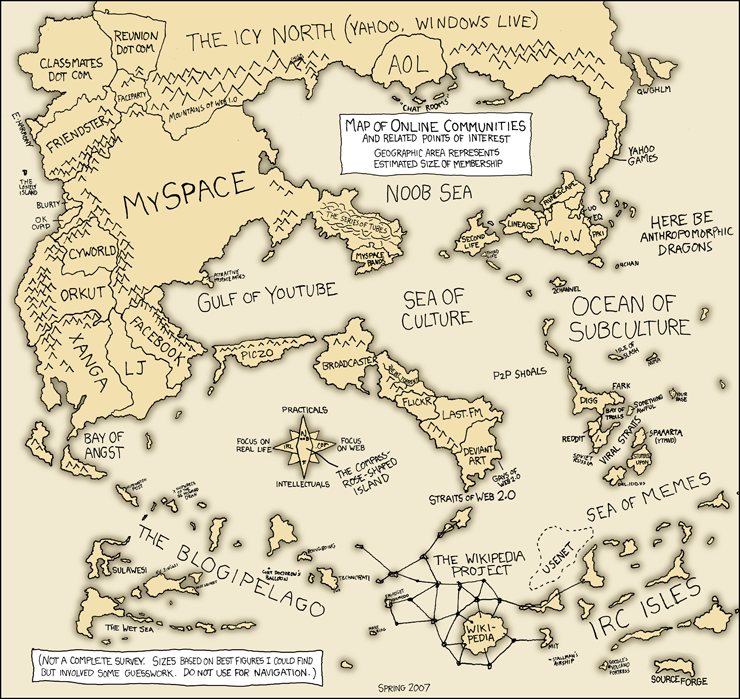
As an aside, the probable reason for my not finding these utopian ideals (other than their not existing, of course), is that when I set out to engage in participant observation of the Internet, I did what appears to be counterintuitive these days, and set my field location to a place I could point to on a map (not this map). In the end, I find that this perspective has been a refreshing and far less, well, viscous approach to understanding the impact that computers and the Internet have on people (as opposed to users).

Above all, through web-based research I have found that the content readily available on the Internet makes the enterprise feel, more often than not, helplessly futile. On occasion, what I find is enlightening and enriching, but, alas, I fear that will never outweigh the instances when it is hopeless and uninspiring. Anthropologically à propos.

In my current fieldwork, it was a pleasure to get away from the mindboggling amount of meaninglessness which assaults me at every turn in my own daily forays into the depths of the web (not to mention in academia...). The more I try to understand about people through online content, the less I want to keep digging and trawling through a muddy jungle of misinformation, aggression and frivolity that is of Amazonian proportions and just as venomously charged.

Like Wikipedia^, then, it is for this reason that Twitter gets under my skin in a most uncomfortable way. It doesn't mean anything. It is genuinely uninformative, ego-centric and self-obsessed drivel. The audience is no one and everyone; the subject is nothing and everything. I don't need to know when someone brushes their teeth or takes out the trash or picks their nose. I really don't. Humanity is exceptionally ridiculous. We seek out freedom of expression as our one and only avenue to universal truth, then we turn it into a free-for-all reality televisionification** of daily banality. A like mind explains it well.

But still, in all my inherent negativity ... I am saddened by the initial hopes that the "idea" of Twitter (though not only Twitter) stirred in me upon discovering it. Its romantic potentiality still calls to me from beyond its disappointing reality. As a quirky tool for relaying to oneself and their friends or strangers some spur-of-the-moment lucidity or lack thereof, it remains (at least) generally amusing, and (at best) even cathartic. I foresaw the temptation of running to Twitter when I coined some spectacularly funny turn of phrase, clever insight or revelation which could so easily be lost among the 50,000 processes running off my mental CPU at any moment. (It never actually happened.)

But what about the fleeting thoughts which lead to some much-needed invention, a solution for world hunger, the first step to the eradification of stupidity as social doctrine ... or any other great idea otherwise lost and without audience? Similarly singular lines of thought have launched revolutions and have defined whole eras in human existence. After all, if we stopped engaging in the silly and pointless for the sake of intellectuality, it would be counterproductive. Much of what is worth knowing and doing in life is found in the absense of forethought or any explicit search for meaning.

So in insulting Twitter, am I scoffing over the potential for quality because my academic mind resents minimalized quantity? Perhaps. But the truth is that the McNuggetization*** of thought is not the same as literacy. Still, that doesn't mean that Twitter can't be a genuine tool for the betterment of humankind. After all, I learned through Twitter that I really don't care as much about what other people do and think as I thought I did (or should).

Call me a snob, but I draw the line when people start microblogging about their underpants.

* Man, I've just googled it and it turns out that this word isn't my own invention.

** Wow, this either ...

*** I give up.

^Edit: Those not familiar with my rants on Wikipedia may not agree with my analogy here. I find Wikipedia to be a source of knowledge as potentially useless as it is helpful. I like wikis in general and think that they can be extremely beneficial collaborative research tools and repositories of information when implemented correctly. Like most people, my Google searches and inevitable Wikipedia trawling probably make up more of my common (non-specialist) knowledge than I'd like to admit. But it remains unreliable as a source of factual data and for as long as the content remains disputed, everything it contains needs to be taken with a grain of salt. This is something I have difficulty conveying to people. The same people who agree that you can't trust anything you read on the Internet will cite Wikipedia with glee. Maybe it's the suffix. I have problems accepting assignments from my students which cite Wikipedia as an authority, because it is authorless, unaccountable and open to being edited at a whim. The extent to which its reliability compares to that of peer-reviewed academic writing is another blog post entirely. In short, I see Wikipedia as gap filler in my knowledge on certain subject areas where I have little to no awareness, but the bits of information I glean from it are partial and almost inevitably biased. I use it out of laziness to truly investigate a subject or ignorance as to how to go about it. In this way, it it feels rather like empty calories, and is therefore analogous to my view of Twitter.

Digg!
Add to del.icio.us

Point and click on the go

Perhaps integrating similar and/or related services will improve Google Street View?

Geovector, Cybermap local search solution for mobile phones
Geovector, a provider of pointing based search solutions, and CyberMap Japan, owner of mapping services provider Mapion, have launched Mapion Pointing Application 2.0, called Mapion Pointing Appli, for mobile phones in Japan. This upgrade reportedly transforms Mapion's existing Geovector pointing mobile search service into a fully commercial application. Mapion Pointing Application allows users to easily find and launch content by pointing and clicking mobile phones at retailers, restaurants, historical sites or any of Mapion's 700,000 Points of Interest (POI) across Japan. The service combines Mapion's POI data with Geovector's pointing based technology and spatial search engine. The new release include features such as user driven opt-in advertising, sponsored categories and preferred placement. The service was initially launched over the KDDI network in January 2006, and is now available for download with Sony Ericsson models W32S, W41S, W44S and W51S phones, the W41K by Kyocera, the W42CA by Casio; and in July, with the W52S from Sony Ericsson. [source]


. Digg!
Add to del.icio.us

Coca-Cola Co. is creating a virtual teenager hangout like MySpace and Facebook, only on cell phones, to lure more youngsters to its sodas and flavored drinks, starting in the United States and China. Eyeing the success of mostly desktop computer-bound teen social sites run by media companies, like News Corp's MySpace, the world biggest soft drink maker said on Wednesday it was creating a cell-phone network under its Sprite brand where members can set up profiles, post pictures and meet new friends.

Coke, part of a growing group of advertisers putting ad campaigns on cell phones, will make the U.S. site available to Web-ready phones on June 22. It launched in China last week and is eyeing other markets in regions like Latin America.

"The Coca-Cola Company needs to continue to recruit future generations of consumers," said Mark Greatrex, senior vice president of marketing for Coca-Cola. "Mobile marketing is absolutely where it's at for us going forward." [more]


. Digg!
Add to del.icio.us

YouTube goes mobile

YouTube.com co-founder Steve Chen has said that consumers in many areas of the world will be able to access videos from YouTube through mobile phones by next year. He made his comments to a group of enthusiastic Web users at a forum on Internet developments in Taipei. The Taiwan-born entrepreneur said he expected that clips between 30 and 60 seconds would attract commuters on subways or buses.

As for those who travel by train, clips of up to 10 minutes will be most popular to pass the time, he believes. He said that as technologies continue to develop at a rapid pace, web sites should keep up by offering richer content and greater mobility so users can access the content from almost anywhere.

Chen and his family emigrated to the United States from Taiwan when he was eight years old. In 2005, he setup the video-sharing website in San Mateo, Calif., with colleague Chad Hurley. The company, which was once run mainly out of a garage, sold to Google for $1.65 billion last year, and all because Chen and Hurley needed to find a way to get videos to each other that were too big for email. [source]


. Digg!
Add to del.icio.us

WiTricity

Why is this taking so long to achieve?

Wireless energy promise powers up
A clean-cut vision of a future freed from the rat's nest of cables needed to power today's electronic gadgets has come one step closer to reality. US researchers have successfully tested an experimental system to deliver power to devices without the need for wires. The setup, reported in the journal Science, made a 60W light bulb glow from a distance of 2m (7ft).

WiTricity, as it is called, exploits simple physics and could be adapted to charge other devices such as laptops. "There is nothing in this that would have prevented them inventing this 10 or even 20 years ago," commented Professor Sir John Pendry of Imperial College London who has seen the experiments. "But I think there is an issue of time. In the last few years we have seen an exponential growth of mobile devices that need power. The power cable is the last wire to be cut in a wireless connection." Professor Moti Segev of the Israel Institute of Technology described the work as "truly pioneering".

Energy gap
The researchers from the Massachusetts Institute of Technology (MIT) who carried out the work outlined a similar theoretical setup in 2006, but this is the first time that it has been shown to work. "We had a strong faith in our theory but experiments are the ultimate test," said team member Assistant Professor Marin Soljacic. "So we went ahead and sure enough we were successful, the experiments behave very much like the theory."
...
"These results are encouraging. The numbers are not far from where you would want for this to be useful," said Professor Soljacic. The system exploits "resonance", a phenomenon that causes an object to vibrate when energy of a certain frequency is applied. When two objects have the same resonance they exchange energy strongly without having an effect on other surrounding objects. ... Instead of using acoustic resonance, WiTricity exploits the resonance of low frequency electromagnetic waves.

HOW WIRELESS POWER COULD WORK
1) Power from mains to antenna, which is made of copper
2) Antenna resonates at a frequency of about 10MHz, producing electromagnetic waves
3) 'Tails' of energy from antenna 'tunnel' up to 2m (6.5ft)
4) Electricity picked up by laptop's antenna, which must also be resonating at 10MHz. Energy used to re-charge device
5) Energy not transferred to laptop re-absorbed by source antenna. People/other objects not affected as not resonating at 10MHz [source]


. Digg!
Add to del.icio.us

I can see my house from here ...

I realize that this is extremely delayed due to my recent lapse in posts and the fleeting state of news in the blogosphere, but I feel that it is worth posting nonetheless. Google has launched its Street View option on Google Maps (US). I spent some time browsing the few available streets in my hometown and concluded that if I am ever in need of a street-level view of a particular building or square foot of pavement, it might come in useful. Over all, however, the novelty seemed to wear off quickly as I found the display increasingly choppy and I struggled to find something worth looking at. As a service, it would probably be better if it were integrated into Google Earth as a desktop application, rather than Google Maps as an online tool.

Of course, there are more critics of this new service than there were of governmental wire-tapping. A host of unethical and dangerous activities are quoted as possible threats to personal privacy and safety. I am undecided as to whether or not this is a good idea, because all good ideas can often be perverted into bad ideas. However, what does interest me is how this relates to the ever-increasing confusion over what constitutes "public" and "private" space. In many (if not all) countries around the world, new technologies - from mobile phones to satellite imagery - are changing the ways in which people interact with, and understand, spatial demarcations in everyday life.

Here's an excerpt from the article:

"There's a distinction between what Google has a legal right to do and what is the responsible thing to do," said Bankston, who believes the company should have blurred the images of unwitting pedestrians before it posted the street-level pictures. "It's a problem we as a society have to grapple with, and I think we are just now seeing the fault lines emerge." While he thinks some of the issues raised by Google's new service are prime fodder for a healthy debate, Weinstein worries that it might inspire overly repressive laws.

"It's a tough area, but it just seems there is no way around the fact that public spaces are public spaces," Weinstein said. "You don't want to create an environment where it becomes illegal to take photos in public. It can be riskier not to be able to see something than it is to be able to see something."


. Digg!
Add to del.icio.us

Lifecasting your lifestream?

The following is a summary of a recent BBC article regarding the hyper-connectivity of mobile devices and their relationship to a new generation of Internet content. It makes a few interesting assumptions regarding social changes in light of advances in mobile connectivity. As has already been discussed here, the ubiquity of social networking sites, blogs, file-sharing, and mobile phones, has led to a somewhat predictable outcome: an ever-intensifying desire among many users to know - and, more importantly, to announce - every minute detail of their own and others' lives. This has apparently spawned the term "lifecasting", which, I suppose, is quite appropriate, but suggests a rather warped definition of 'life'.

The new services allow users to produce web-based content from their mobile phones 'on the go' which can then be distributed via existing social networks to virtually anyone, in real time or in archive form. It is important to reiterate, however, that the sites are very likely to be (co-)dependent upon several existing services as much as they might stand on their own. For example, while Twitter is somewhat conceptually self-sufficient, it depends on mobile phone users with mobile phone contracts and services. Furthermore, one's network of Twitterers (?) is likely to overlap with MySpace contacts, Facebook friends, etc. Thus, the interest in these sites at all (with the acceptance that any one can be a fleeting fad) is their interconnectivity.

Speaking of connectivity, then, the article suggests two things: that hyper-connectivity - the facility and ability to be 'connected' all the time, and, presumably, actually making use of this connection - will be a pre-requisite for life in the near future. Secondly, this hyper-connectivity has given rise to two behavioral changes: hyper-honesty and egotism. In short, a hyper-connected individual has no qualms about publicly sharing the most intimate, minute-by-minute details of their lives, when, and only when, they choose to do so. They will likewise only contribute or respond to others' information when it is suitable to their schedules or desires, without any expectations otherwise.

If this is true, it suggests that there is a behavioral trend towards individualization of one's expectations as a social being, which, of course, questions the concept of sociality as a whole. As I am fond of pointing out, this is not such a unique phenomenon since the arrival of the mass consumer Internet in the 1990s. Take emails, for instance. It is very easy to receive an email and neglect to reply to its sender due to the nature of its content (emails can be short and fleeting) or the nature of its form (even longer, detailed emails can be lost in the inbox, never to receive a reply). Gone are the days when every carefully crafted 'letter' was returned with at least an acknowledgement. Conventions of writing and typical courtesies of response are no longer upheld because 'it takes too long'. Presumably, this was also found to be the case when long, hand-written letters were phased out by short, regular telephone calls.

Finally, hyper-'honesty' seems like the wrong word to use, as that implies an assessment of truth. Instead, it can be said that ubiquituous connectivity can make people more 'open' or willing to share personal information. Does any of this actually make people (we're talking about human beings, remember?) more honest or egotistical than usual? Or are they (we) just becoming more readily exposed?

Hyper-connected generation rises
Internet services such as
Twitter, Jaiku and Kyte TV are giving rise to a "hyper-connected" generation. An increasing number of applications has been launched that take advantage of "always on" connections, either over the net or on mobile devices. Users are not just sending texts and e-mails, but are "lifecasting" words and video 24 hours a day.


"It's a lifestream of your activities - both in the real world and online," said Jaiku's Jyri Engestrom. "We are seeing the logical continuation of a trend, with services like MySpace, Bebo and Facebook, " he added. Unlike e-mail or a basic SMS message, hyper-connected services are not just one-to-one; messages are "one-to-many", broadcasting via the web, on multiple sites, and on mobile devices as a form of mini-blog. Minute-by-minute accounts of your life and even live video can be posted inside social networks such as MySpace and Bebo, or experienced via a mobile phone.

"In five years time being hyper connected will become a necessity to be an active participant in the social world" ... Jyri Engestrom, Jaiku. "It's an ambient, not a disruptive service," explained Mr Engestrom. "You can follow the lives of your friends when and how you want - either via your phone, your Jaikiu page or via their blogs and websites."
...
"The webcam era was limited to people sitting at computers or in their room. By having wi-fi and 3G connections, people can broadcast anywhere to anyone."
Mr Engestrom said the hyper-connected had given rise to the hyper-honest. "This new generation is much more comfortable with openness and honesty. The young generation are happy to share their lives publicly. He added: "Being-hyper connected will become a precondition for citizenship. "In the same way mobiles are a necessity, in five years time being hyper-connected will become a necessity to be an active participant in the social world."
[source]


Digg!
Add to del.icio.us

top