


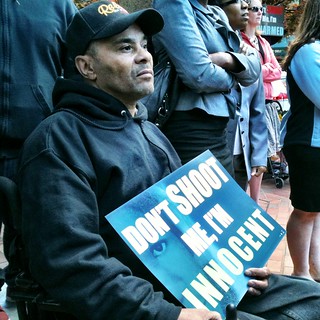
 I was not planning on weighing in on this topic of much media and public attention, until I read this AAA/HuffPo piece. Racial and ethnic conflict, nationalistic labels, perceptions of distance and of inter-racial or race-related violence are all topics that I explored rather thoroughly in my PhD thesis (titled Urban Firewalls for some of these exact reasons). What initially started out as a brief comment in response to Ashkuff's post at the OAC has evolved into something more, and I am posting it here with some duality: 1) as an anthropologist analyzing concepts of social distance, and 2) more subjectively as a citizen of the United States who has recently returned from abroad to a country where it is easy to feel like a foreigner on the wrong side of a firewall.
 Race is a powerful word, yet it is in key ways little more than an arbitrary label; it's just another term wielded by those threatened by difference to put distance between the Self and the Other. For anthropologists, it's fascinating stuff. Yet I can't address it only as an anthropologist or remove all personal emotion here. I'm culture-shocked, and you should be, too. I say this as a concerned citizen: the question is not whether or not Zimmerman is guilty (he shot an unarmed person), it's what the hell are we doing (we let him have the gun in the first place)?
In somber cases like that of Trayvon Martin, it is worrying that race/ethnicity are so easily played to suit the whims of commentators and politicians obliviously clowning around in a giant election year performance. So wearing my citizen hat, I argue that race is being used here once again to draw attention away from more critical issues bubbling at intense heat right below the surface. By fixating on race, we avoid asking other questions that Americans are afraid to ask out loud ... or at least afraid to answer. I'm talking about gun control and personal (in)security and the rampant fear and distrust between Americans that causes them to not only buy, carry and use lethal weapons, but also to demand them as a basic right of all citizenry while healthcare, on the other hand, is seen as a privilege to be earned. Popular media outlets have once again shown twisted, misanthropic acceptance of the act of shooting someone, to ruminate instead on the whys and wherefores of race.
Back up past race for a moment. Why is it acceptable to talk about "standing one's ground" with "deadly force" as if it should be anything but reprehensible (let alone legal) to inscribe hatred and fear into the very geography, street by street? In the US, it makes no difference what "race" you self-ascribe to or are inadvertently shoved into, or even if you reject the concept entirely. Like the religious trying to condemn an atheist to their imaginary hell, the concept of "race" continues to stubbornly be used to categorize even those who dismiss its validity, and to determine the various levels of freedom (not nearly an absolute concept in the hands of patriots, it seems) that each category of person should be afforded or have restricted.
That's the irony of a democracy run by and for special interest groups, where civil rights are wantonly thrown to the wind, and where putting "positive" before "discrimination" is meant to cancel it out. All Americans - yes, all, like it or not - are engaged in this ongoing game of hatred and distrust using the dated and meaningless category of "race" to mask the fact that the "land of the free" is anything but.
Back to the anthropologist hat now, conceptualizing a sliding scale of nearness and distance to categorize one's social and physical environment is universal and natural. It is one of the most basic and fundamental traits of humanity: to divide up our sensory world in order to better manage it and better manage ourselves in it. Dealing with the problematic gray areas and taboo zones and semi-permeable imagined boundaries is what being human is all about. There is no "us" without "them" and vice versa. In-groups and out-groups have always been a reality for human and non-human primates alike. Yet it seemingly takes the infinite stupidity of present-day America to repackage the autonomic fight or flight response into deadly "stand your ground" legislation.
If this were happening in any other place, we anthropologists would be poking and prodding its peculiarity, unable to restrain ourselves from passing judgment or even taking action. Do we feel powerless to affect change in our own societies? In the case of the US, I feel like a majority of voices in the public sphere - social researchers included - are guilty of taking the race debate at face value. Not challenging the race paradigm is not "objective"; it's lazy and probably even negligent. So I venture here that, save the most obvious and superficial details, the critical reality of the Trayvon Martin case cannot be explained away by "race". And as long as we keep arguing that it can, this dangerous word will continue to gain currency.
... to buy bullets with.


